Remodel

I’ve been seeing my new therapist for several weeks and today faced uncomfortable truths, which I find difficult to write about articulately.

A student of mine wrote an essay this last week in which she narrated her personal experience with bullying and the trauma caused by these abuses. I too was victim to bullies as a child – both the physical “school yard” variety and the menace that is middle school cliques, whose psychological torment seems to be almost exclusively the tool of girls in early adolescence. While cyber-bullying has created a new sphere of isolation for victims and a grander stage for hateful, damaging abuse, the impact for the victims is much the same. Those who survive relentless teasing, rumors, threats, or actual physical attacks, are left with years, if not a lifetime of insecurities and a severely limited capacity for trust.

I am thankful in many ways to have grown up before social media existed. I cannot image the difficulties young people now face when negotiating this, seemingly unavoidable, omnipresence in their lives. My bullies were necessarily limited by the confines of school buildings and adjacent playgrounds.

However, something in the voice of my student – the urgency leading her to share her story – spoke to a part of me I have long sought to, perhaps not forget, but certainly silence.

The truth is the girl who survived daily abuse at the hands of other young girls, from third grade through middle school, has lived within me, jealously guarding my fragile self-identity, while I have grown and strengthened my resolve to never need the approval, or trust the apparent approval of others. I have built my life carefully, nurtured trust slowly with a few, long-term friends, whom I love with an unquestionable ferocity. I give to these few all that I can and there is nothing dishonest in these relationships.

When it comes to matters of my own needs and, more to the point, my own ideas of what I deserve – my own value – I am not so resolved.

We all have places where our edges are sharp and ragged. Within each of us there are wells of shadow, places we know exist. Sometimes we move toward the vastness to lean in, but more often we stay away. One of my wells holds my younger self: who feigned illness to avoid attending school; who got in fights with other outsiders to try and disassociate with otherness; who wanted so desperately to be left alone to continue to be strange, thoughtful and anonymous. The well she inhabits has also filled with abilities I know I should have: vulnerability and self-love, the resolve to trust that those who love me truly see me and the person that they see, can be allowed to be vulnerable and understand that she is worthy of this love.

You see, it is one thing to know that you can love another. It is entirely more complex to understand, with all the splintering and holes, the shadows and protections, the walling off and silencing of experience, that the person I AM – all of it – is worthy of being loved.

How do we become this complex? Years of constructing – careful design in some ways – self-preservation resulting in varied forms of harm and misdirection. But, ultimately we are the architect and can discover where we need remodeling – an opening of space – windows – a library – to fill in a well.

This path will lead me somewhere. This is me today:

GetAttachment

Sights and Smells

Denuded

Chimamanda Ngozi Adichie begins Americanah with the following line:

Princeton, in the summer, smelled of nothing, and although Ifemelu liked the tranquil greenness of the many trees, the clean streets and stately homes, the delicately overpriced shops, and the quiet, abiding air of earned grace, it was this, the lack of a smell, that most appealed to her, perhaps because the other American cities she knew well had all smelled distinctly. (Americanah, page 3)

I’ve only just begun this novel, the second that I have read from Adichie, and now several chapters in, it is this line that sticks with me. The smells of places become part of the identity formed in our memory. I remember my childhood as the working waterfront smell – fishing boats and low tide with undertones of fried food. My maternal grandmother as Ciara perfume and my Poppi as apple pipe tobacco. The air in both Tacoma and in Portland, Oregon was damp and often heavy to breathe with rich, plant smells. My home in Portland smelled of Chandrika soap and compost.

I have found myself revisiting these truths of memory and finding they are equally present for seasonal changes. My awareness of this awakened when I moved back to Maine in 2010, where each season has a distinctive aroma, particularly if one lives somewhere rural. I returned to Maine in April of that year, which is widely known as “mud season.” The long awaited thaw has (hopefully) begun, trees take on a fuzziness, not quite budding yet, snow relinquishes control of the  Earth, causing flooding and, as the name implies, treacherous, calamitous, mud. That oozing dirt has a life and odor of its own, and it is in this chaos, which will yield to crocuses and ferns, that Spring finds its nose.

I was itching to dig in the dirt, having just returned from years of living without a garden of my own, and I found this smell intoxicating and was baffled by this. How could I not have known that this is the smell of Spring? The answer I came to embrace is that Oregon and Washington have this smell nearly year round. The Northwest is in an almost perpetual state of decay and rebirth; there is hardly a freeze from which to revive.

And so it was – Summer is goldenrod and honeysuckle, Autumn rotting leaves and burning leaves and Winter wood stoves and air cold enough to have no smell whatsoever.  Note: people in all seasons have their own odors and in Maine these are not unlike the seasonal smells, particularly in rural places.

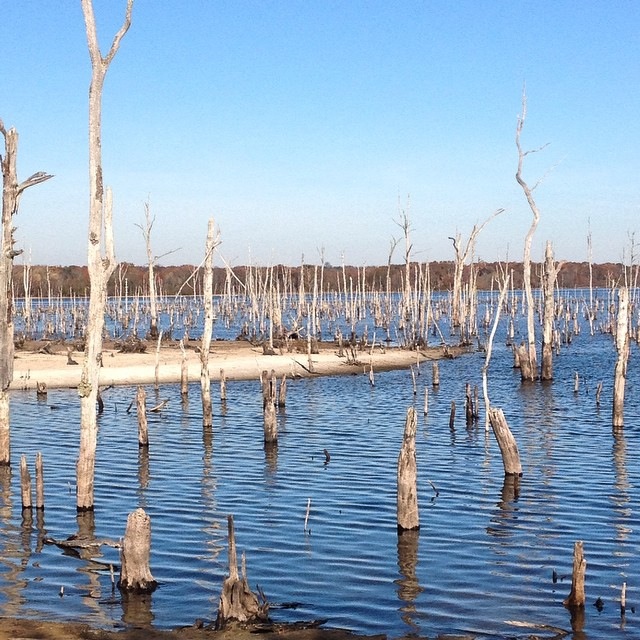
I have been thinking about this a good deal since beginning Americanah and realized today, while walking around a reservoir about half an hour from my new home, that part of my feelings of disorientation here have to do with how confusing New Jersey smells.

The loop around the reservoir is about four miles, mostly loose gravel trails, with an occasional foot bridge. There are remnants of the forest which preexisted the reservoir, Great Grey Herons and several varieties of duck make their homes. People fish and ride trail bikes. The trails are, for the most part, separated from the roads running all around the parameter by trees which in Summer probably do lend some weight to an illusion of wildness. But the smells are telling.

In the two hours we walked, I was struck that the leaves have not rotted enough to have a detectable smell, the air while dry and cool, does not carry hints of any late blooming plants, and even the water was mostly without odor. I was also aware that I was really trying to smell something natural in this place which, unlike most of the places I have been since moving here, is attempting to be something other than a suburban wild space. And perhaps this space is convincing for some; I know I have been ruined by Maine.

More confusing to my senses were the various smells coming from fellow walkers, runners and bikers. One expects to smell sweat and the occasional overly concerned perfume or cologne wearing exerciser, those are found everywhere. Instead, I was hit with Febreze like smells and detergent, smells far too sanitized to reveal that inside of them were human bodies. Feeling the sweat drying coldly under my own arms, the vague fragrance of my shampoo released as my hair grew damp with perspiration, I felt suddenly foreign. I do not like to “smell of nothing,” I never have. Moreover, I like people to smell like people. Or, at the very least, I like people to smell like what they eat, their work, or their homes. And it is this last thought which struck me. The striving for impossibly clean – not work, not food, not sweat, not dirtiness -smell may be what I find difficult. I have lived always in another kind of place, where people are less concerned, where cars are not all new, where there is no right outfit to workout in, where bodies smell like bodies and rot like rot. I know that much of America is not like this reality I have lived. Or, at least, I am beginning to know. It is strange to be thirty-seven and to feel that there is this other America that I have not lived. Much is familiar, but just as much is so very strange. I can walk here and sit by this reservoir and recognize the signs of life I enjoy – the trees, the changing and falling leaves, bird songs and the mad dash of squirrels and chipmunks – I can do this but I will still smell the difference and it will not feel correct. For now, I long for the sure signs of Autumn that Maine reveals so effortlessly. For now, I will search them out and hope for them in whatever small and perfect ways they may exist. I know I will find something I recognize, even in fleeting moments, if not, in my recent and still potent memories.